Why a driveway is the highest-stakes flatwork job here
A driveway carries more design load than any other flatwork on a residential lot: vehicle weight, concentrated at the tire contact patches, day after day. That load is exactly why a driveway is also the flatwork most exposed to Stafford's expansive clay: a heavier structure sitting on a soil that swells and shrinks seasonally means more weight riding the same differential movement that cracks a lighter patio slab. Get the base prep, thickness, and joint spacing right and a Stafford driveway can go decades. Skip the soil-specific steps and it's a resurface-or-replace conversation inside a few years, no matter how good the concrete mix was on pour day.
What a properly built driveway looks like here
- Thickness. ACI guidance sets a 4-inch minimum for a typical residential driveway, stepping up to 5–6 inches where heavier vehicles or freeze-thaw exposure apply. Stafford's near-freeze-free climate removes the freeze-thaw reason to go thicker, but the differential-movement risk from the expansive clay is a separate argument for not cutting the 4-inch minimum close, especially on a driveway that will see anything heavier than a standard passenger vehicle.
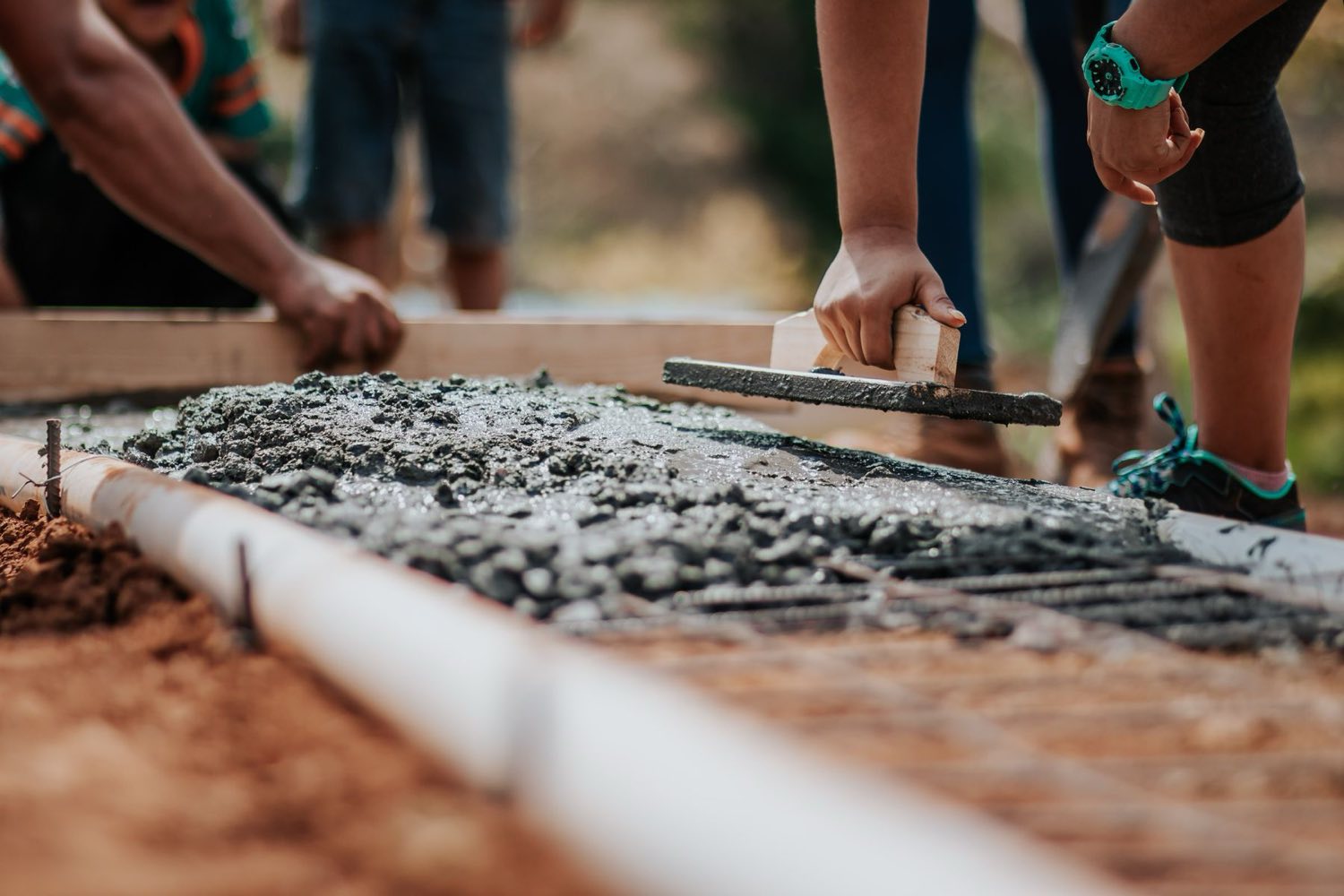
- Reinforcement. Welded wire mesh (commonly 6×6 W2.9) is the standard crack-control reinforcement for residential driveways. It distributes shrinkage stress across the slab but doesn't add structural strength on its own. Rebar (commonly #3 bars at 18 inches on-center) steps up to real structural reinforcement where the load or the soil movement calls for it, a reasonable upgrade on clay, since differential movement puts more stress through the panel than uniform shrinkage does. Fiber mesh mixed into the concrete supplements either by reducing plastic-shrinkage cracking in the first day, but doesn't replace connected steel.
- Base prep. This is the step that matters most on Fort Bend clay. The subgrade should be compacted to roughly 95% standard Proctor density (ASTM D698), then a 4–6 inch layer of compacted #57 crushed stone (AASHTO M43 gradation) goes down before the pour. That base course is what separates the slab from the active clay layer underneath it and gives water a path to drain instead of pooling under the concrete. See clay soil & cracking for the full mechanism this base prep is defending against.
- Control joints. ACI guidance calls for joint spacing of 24–36 times the slab thickness, with the tighter 24× end applying under high-shrinkage placement conditions: hot, dry, windy pours, which describe a large share of the Stafford construction season. For a 4-inch driveway that works out to roughly 8–12 feet between joints; many contractors work the tight end of that range on driveways specifically, since they're exposed to thermal cycling on all sides, not just one face. Saw cuts should run at least a quarter of the slab thickness, and panels should stay under a 1.5:1 length-to-width ratio to avoid long, crack-prone strips.
- Finish. Broom finish is the standard for driveways. It's textured for slip resistance where a smooth troweled finish would be a liability underfoot or under tires in wet weather.
The apron / right-of-way note
Where a driveway crosses the public sidewalk or parkway strip into the right-of-way, that portion, called the apron or approach, is commonly governed separately from the rest of the driveway by the local municipality, not just by general concrete standards. Patterns seen across many jurisdictions include a right-of-way or encroachment permit before work starts, a thicker apron section (often 6–8 inches) with continuous rebar, inspection both before and after the pour, and a prohibition on stamped or colored concrete in the right-of-way. These are generic patterns, not a confirmed Stafford ordinance. The exact rule (thickness, permit process, who's responsible for the apron) is jurisdiction-specific and should be confirmed with Stafford's public-works or engineering department before scoping that portion of the job.
What it costs
Driveway installation typically runs $8–$18 per square foot, putting a standard two-car driveway around $6,000 in national cost data. Driveway repair averages about $1,812, with a typical range of $830–$2,838. These are typical ranges from national cost aggregators, not a quote. The cost page has the full driver list, including why base prep and drainage correction weigh more heavily on the number here than in a non-clay market.
Repair, resurface, or replace
If an existing driveway is already cracked, heaved, or faulted at the joints, the decision runs through the same mechanism explained on clay soil & cracking: cosmetic cracks get sealed, a settled-but-sound slab gets lifted (slabjacking or polyjacking), a structurally sound but worn surface gets resurfaced, and a heaved or structurally failed slab gets torn out and replaced. Whichever path applies, the base prep and drainage cause has to be fixed too, or the new work cracks on the same schedule.
Bottom line
A Stafford driveway is a base-prep and jointing job wearing a concrete-mix job's reputation. The mix strength matters, but the base compaction, the separation layer, and the joint spacing are what actually decide whether the driveway survives this soil. See cost for typical pricing and what moves it, and clay soil & cracking for the full mechanism.
Area covered
Stafford 77477, and the surrounding Fort Bend County area.