The one mechanism behind almost every crack
Concrete cracks for four standard reasons: plastic shrinkage, drying shrinkage, settlement, and structural overload. All four are real and all four happen in Stafford. But underneath most of the structural and settlement cracking in this specific market sits one repeating physical cause: the clay under the slab changes volume with the weather. That mechanism plays out in a specific way on Stafford's own soil, and it shapes what to do if you're already looking at a cracked or uneven slab.
The soil, measured
Stafford sits in the Fort Bend Gulf coastal-prairie clay belt. A USDA Soil Data Access point query run at the Stafford centroid returns a dominant soil component of Bernard clay at 60%, with a measured maximum-horizon Liquid Extraction Percentage (LEP) of 7.3%, which clears the standard expansive-soil threshold of LEP ≥ 6%. Edna clay is co-dominant at that point. Bernard is officially described as "fine, smectitic, hyperthermic Oxyaquic Vertic Argiudolls," a Mollisol with strong vertic (shrink-swell) properties: 34–49% clay, very slow permeability, high runoff, and grooved, polished pressure faces on peds that are the textbook physical signature of a soil that has been swelling and shrinking against itself for a long time.
The wider county association is Lake Charles clay, a true Vertisol whose official type location is in Fort Bend County. Lake Charles runs 45–60% clay in its control section, and its official soil description records dry-season cracks a half-inch to two inches wide at the surface, extending 12 inches or deeper, staying open 60 to 90 cumulative days in a typical year. Which series dominates a specific Stafford parcel is part of a mix. The measured point comes back Bernard-dominant with Edna co-dominant, while Lake Charles remains the county's signature Vertisol rather than a guaranteed per-parcel dominant. Texas's own guidance on expansive soil flags a Coefficient of Linear Extensibility (COLE) above 0.06 as capable of causing structural damage to slabs and foundations. Either way the local answer is the same: this is genuinely expansive clay, not a marketing claim.
How the clay actually cracks a driveway or patio
Smectitic (montmorillonite) clay is the mineral responsible: it swells when water gets into its structure and shrinks when that water leaves. Cast a slab on grade over that clay and the slab rides the soil underneath it: lifted where the clay swells, dropped where it dries. Because moisture exposure across a yard is never even (a dry, sun-exposed edge next to an irrigated flower bed, a tree pulling water from one side, roof runoff concentrating at one corner), the movement is differential, meaning different amounts in different places under the same slab. Differential movement, not uniform settling, is what actually cracks, heaves, and faults concrete: it opens transverse or diagonal cracks mid-panel, lifts or drops individual panels relative to their neighbors, creates a faulted step at a control joint, and can pull flatwork away from an attached structure like a porch or garage slab.
In Stafford specifically, that cycle runs on the region's drought-then-soaking-rain pattern: the clay pulls away and settles under one edge during a dry spell, then heaves back as it rehydrates with the next rain. The mechanism is identical to the one that moves house foundations on this same soil. The difference is that it acts on flatwork and slabs instead of a structural foundation.
Reading a crack: pattern and width both matter
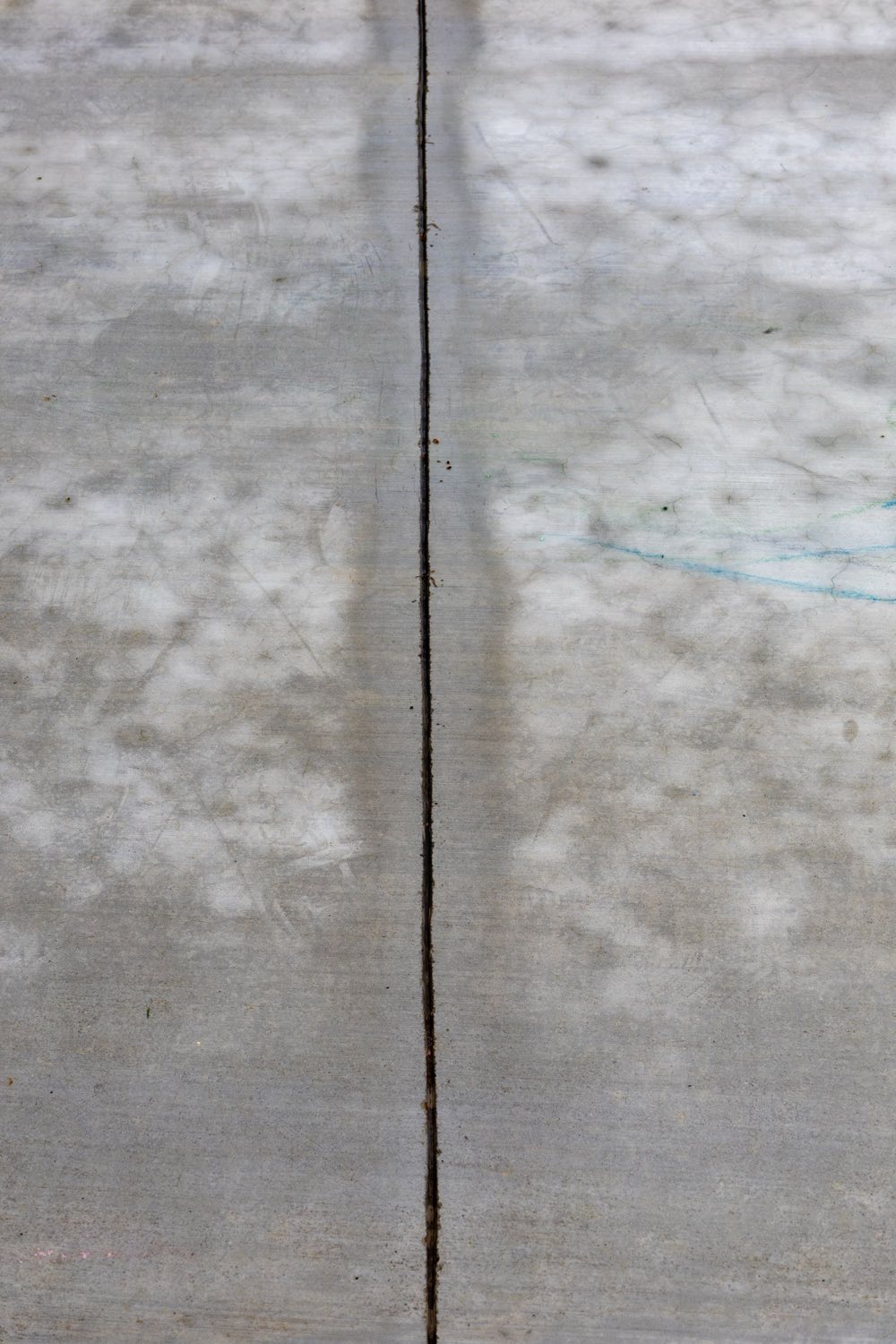
Not every crack means the clay is moving. Two reads, together, tell the story:
- Random, web-like map cracking (crazing) is surface drying-shrinkage, the slab losing moisture as it cures over weeks to months. Cosmetic, usually.
- A single straight crack mid-panel that doesn't line up with anything is often shrinkage that simply missed the nearest control joint.
- A crack paired with a faulted or stepped joint, or a panel that's visibly tilted relative to its neighbor, is the differential-movement signature. That points to a subgrade problem, which on this soil almost always means the clay.
Width sets the second read, by ACI-consensus rule of thumb: hairline cracks under about 1/16 inch are typically cosmetic shrinkage and can usually be left alone unless they grow or start leaking. Cracks around 1/8 inch or wider warrant a closer look and likely some repair. Cracks wider than 1/4 inch, any crack with a visible vertical or horizontal step across the face, or a crack that runs through the full slab thickness signal a structural concern worth evaluating at the cause, not just patching the crack. Standing water on a slab (birdbathing), or water that drains toward the house instead of away from it, is a related diagnostic. It points to settlement or bad slope, and it matters doubly here because water is exactly what moves this clay.
What actually stops it: the counter-move
Because this is a soil-moisture problem before it's a concrete problem, the fix that holds is one that manages the moisture and the transition between the slab and the active clay layer, not just a stronger mix:
- Subgrade compaction and a separating base course. The subgrade should be compacted to roughly 95% standard Proctor density (ASTM D698; a standard DOT specification figure), then a compacted crushed-stone base, typically 4 to 6 inches of #57 stone per AASHTO M43 gradation, goes down before the pour. On clay, that base course is what separates the slab from the active shrink-swell layer and gives water somewhere to drain instead of pooling under the concrete.
- Correct control-joint spacing. Control joints don't stop shrinkage. They decide where the shrinkage crack goes. ACI guidance calls for maximum control-joint spacing of 24 to 36 times the slab thickness (the tighter 24× end under high-shrinkage conditions like hot, dry, windy placement, which describes a Stafford summer pour), with the saw cut at least 1/4 the slab depth and panels kept to no more than a 1.5:1 length-to-width ratio. A 4-inch driveway slab works out to roughly 8–12 feet between joints; contractors here commonly work the tighter end of that range because the slab is exposed to thermal cycling on all sides.
- Moisture conditioning at the perimeter. The driver is the drought-rain swing rather than a one-time settlement, so keeping the soil around the slab edge from fully drying out reduces the differential movement that cracks the concrete in the first place. That means steady watering in dry stretches, plus grading and drainage that carries roof and yard water away rather than letting it pool at one edge.
None of this is exotic. It's standard base-prep and jointing practice. On this soil, though, skipping it is what turns a normal shrinkage crack into a faulted, heaved mess within a year or two.
If you already have a cracked or uneven slab: repair, lift, resurface, or replace
Because Stafford has one governing mechanism rather than several competing ones, the repair decision here almost always routes back to the same root cause.
- Seal or patch when the slab itself is sound and the cracks are cosmetic (hairline, non-structural, not tracking a faulted joint). Narrow cracks take a standard cementitious filler; a crack that still needs room to move takes a flexible polyurethane or silicone sealant instead. This only holds once the underlying movement has stopped. Sealing a crack that's still opening just gets it reopened by the next dry season.
- Slabjacking or polyjacking when a sound slab has settled over a void and needs to be lifted level, not replaced. Slabjacking pumps a cement-based slurry under the panel through larger holes; polyjacking injects a lighter, faster-setting polyurethane foam through smaller holes and resists moisture better. Neither method reaches deep load-bearing strata, and neither helps a slab that's cracked through or structurally failed. They lift a sound panel, full stop. Longevity claims from contractors commonly put slabjacking around 2–5 years in wet or erosive conditions against 20+ years claimed for polyjacking on stable soil; treat both as contractor-sourced claims, not independent measurements.
- Resurface or overlay when the slab is structurally fine but the wearing surface is worn or dated. A bonded overlay only works if the substrate is properly prepared to the right surface profile. An overlay poured over an unstable or still-moving slab will simply telegraph the same crack back through the new surface.
- Tear out and replace when the slab is heaved, faulted at multiple joints, spalled through, or cracked structurally. This is the only method that resets a failed slab and the only one that makes a crack truly disappear. Even then, replacement without fixing the base prep and drainage first just buys the same problem a second time on this soil.
The rule that ties all four together on Stafford's clay: whichever repair path fits, fix the subgrade moisture and drainage cause first, or the new work re-cracks on the same schedule as the old.
A local placement note: pouring in Stafford's heat
Stafford runs hot roughly four months a year, late May through late September, with average highs in the high 80s to low 90s, peaking around 93°F in August, under intense Gulf sun and high humidity. Hot, dry, windy conditions are exactly the setup that drives plastic-shrinkage cracking, where surface water evaporates faster than bleed water can replace it and the slab cracks before it has even hardened. Those conditions also speed slump loss, which is why timing a pour for early morning or evening and protecting the surface with an evaporation retarder or wet cure matters more here than in a milder climate. Stafford's near-freeze-free winters (a growing season around 320 days) mean the opposite problem, freeze-thaw and deicing-salt scaling, is essentially a non-issue here. That is also why a 4,000-psi-with-air-entrainment mix, a cold-climate requirement, isn't the local standard; a mild-climate 3,000–3,500 psi mix is the common minimum instead. Cure timing follows the same standard curve everywhere: about 75% of design strength by 7 days, full design strength at the 28-day test mark. Hot placement conditions push contractors toward closer attention to curing method, not a different strength target.
Bottom line
In Stafford, concrete cracking is a soil-moisture story first and a concrete-quality story second. The clay under the slab is measurably expansive, it moves with the seasons, and that differential movement is the leading local cause of driveway, patio, and slab cracking and heaving. A slab built with proper base prep, correct joint spacing, and some attention to perimeter moisture holds up. One that skips those steps cracks on this soil's schedule, not the concrete's. See driveways and patios for how that plays out job by job, and cost for what the different scopes run.
Area covered
Stafford 77477, and the surrounding Fort Bend County area.